Using the Lubitel 166b
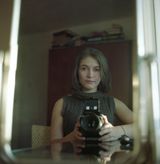
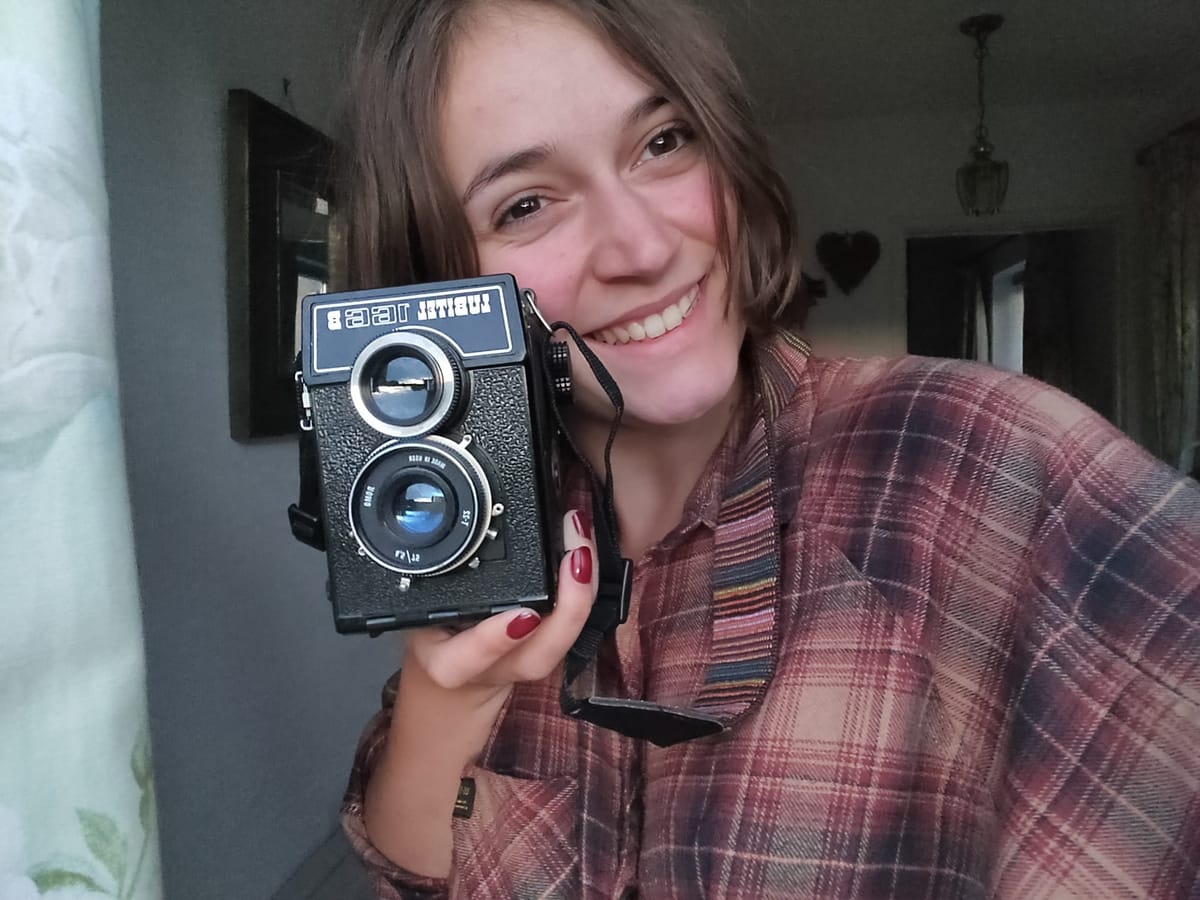
The Lubitel 166b is the first medium format camera that I have the absolute pleasure of calling my own. I was gifted it by my ex-tutor, Lee Gavin who has continued to be one of my biggest supporters, a great friend and a brilliant mentor. I recommend checking out his own photography on Instagram @lee.gav and on his website Leegavin.com. He was one of the first people I told when I found out my degree results, he congratulated me and said he’d send me a card in the post. Come graduation day and amongst the chaos of getting ready a parcel arrived at the door. Within was a box of medium format FP4 film, a card with a cryptic message and a smaller package. Having put two and two together I frantically ripped open the smaller package to reveal my first twin lens camera, the Lubitel 166b!
This camera is 6x6 square format, a format that I had previously experimented with at university with the Bronica SQ. It has a waistline viewfinder that flicks open with little persuasion and two lenses which are countersunk. The top lens is the ‘viewing’ lens, the light coming through this lens is reflected, by a tilted mirror, 90 degrees upwards out the top of the camera through the viewfinder which is a larger window than most cameras have. The lower lens is the ‘photographing’ lens, this is where the light reflected from your subject actually travels through your camera and hits the film at the back. As I mentioned in my previous blog, “Using the Mamiya 7ii”, having a viewfinder window separate from the lens that takes the photo can lead to parallax error, however with the Lubitel it is basically unnoticeable.
Shooting from waist height is a very different experience to shooting from eye line. When shooting something in closer range, such as a person it has a noticeable change in perspective because of the lower angle, you’ll find you’ll catch more of the underside of someone’s face if you are both stood up, especially if the person operating the camera is rather short.... But, when shooting something further away like a landscape this change in height only really has an effect on anything in the foreground. To combat any shorter range issues, I use this camera by lifting it above my head and turning it upside down. It might not look convenient and that’s because it isn’t, but gets the results you might be after. I also find that people are more comfortable having their portrait taken with this style of camera because it isn't linked with the intrusiveness of having your photo taken by someone holding a camera up to their face. With this camera my subject and I can look each other without my face being obscured which makes for a more relaxed environment.
Secondly, the image within the viewfinder is reversed which adds an extra level of concentration when attempting to frame up your subject, it can take time but it is something you’ll naturally become acquainted with after churning through a couple rolls. As for focusing, there is a small circle in the center of the viewfinder, this disc will fade between fuzzy and sharp as you twist the lens to find the focus. Now for those of you that don’t have 20/20 vision, trying to tell if the image inside a tiny circle is sharp, from the distance of your waist with one eye closed is a little difficult, but very conveniently, these cameras often come with an extra pop out magnifying lens so that you can focus your image precisely. For the Lubitel 166b it looks like the most adorable magnifying glass, which flips out from the wall of the viewfinder, the handiest accessory. Once I am happy with my focusing I flip it back down to double check my framing one last time before taking the shot. Simple!
I fell in love with shooting on 120 film in my final year of university, to now have my own medium format camera has been my biggest inspiration. Previously I had never been that person that takes their camera everywhere with them and it was something about myself I was quietly disappointed in, but now, I am that person, I take it with me on all my adventures.
Not only does the camera itself inspire me but I can’t begin to explain how much interest a twin lens reflex camera generates. This thing is a magnet! I’ve never been approached so many times holding another camera. The twin lens’ distinctive look seems to be very inviting to onlookers and I love how fascinated people seem to be when they see you with one, because it is so obviously a film camera rather than a digital. The most common line I hear when I’m approached by someone about the camera is,
“Oh it’s a proper camera! Do people still shoot like that?”
I love that, “a proper camera” hell yes it is! No disrespect to digital photographers but the general consensus is that shooting on film is still the ‘proper’ way... *wink wink*.
The conversations with strangers I have about this camera and the analogue process are always filled with so much enthusiasm and mutual admiration. The older generations have a flutter of nostalgia and reminisce to me about the days of their youth when film was all there was to shoot on. They always leave the conversation with encouraging words and a pride in the fact that the younger generations are keeping the old processes alive.
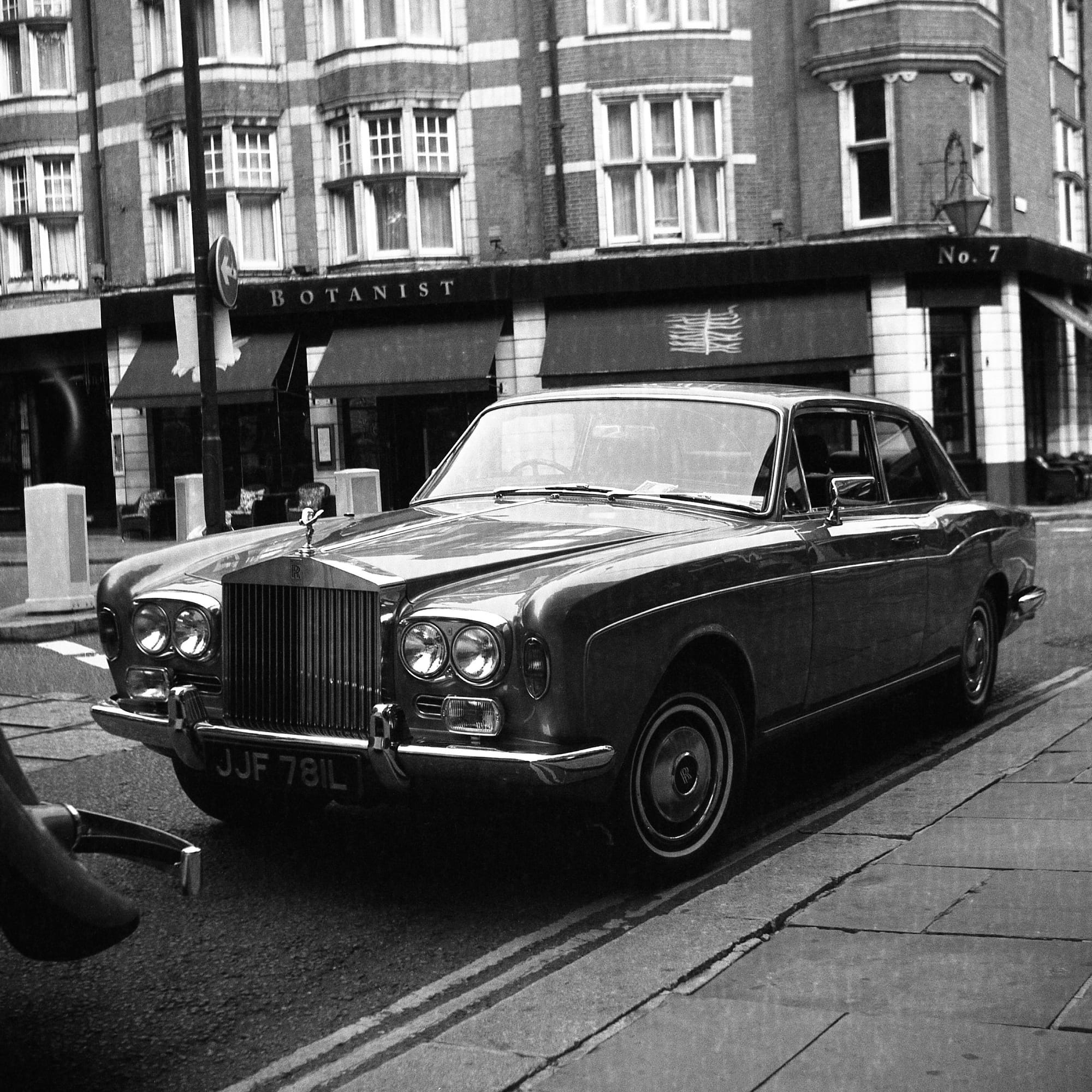
It reminded me of a conversation I had with a gentleman in Sloane Square, he was the owner of a rather handsome, classic, Rolls-Royce and I had stopped to photograph it with the Lubitel on my way to work. I had approached him about his classic car and he noticed I also had a classic hung around my neck. He said that when he takes his oldest car out he is always greeted by people full of enthusiasm, but when he takes his newer sports cars out he is met with competitive egos. He went on to say that people are generally just happy to see old equipment still being used and I completely agree. I have shot on digital most my life, it’s only in the last year I have truly thrown myself into the world of analogue, but, I can safely say that the quality of conversations and stories I’ve had with a film camera slung round my neck have been tenfold to when it’s a digital camera. Maybe I’m biased but that’s my experience with the Lubitel 166b and one of the many reasons why I love shooting film.
This camera has been the reason for me meeting so many new people and as a result of that I have had some wonderful adventures which I will be writing about in my next few blogs so stay tuned!
Until next time, happy shooting.
Eleanor :)